
Article: What Goes Into a $100+ Statement Tote
What Goes Into a $100+ Statement Tote
Every once in a while, someone sees one of my totes and asks a perfectly reasonable question:
What makes a hand-painted tote worth $100 or more?
The short answer is that you're not simply buying a tote bag.
You're buying the blank canvas, the artwork created on it, the dimensional details added by hand, the finishing and protection of those details — and, ultimately, a functional piece of wearable art that was created one at a time rather than produced by the hundreds.
But the longer answer is much more interesting.
So come into my studio for a minute, and I'll show you what actually goes into one.

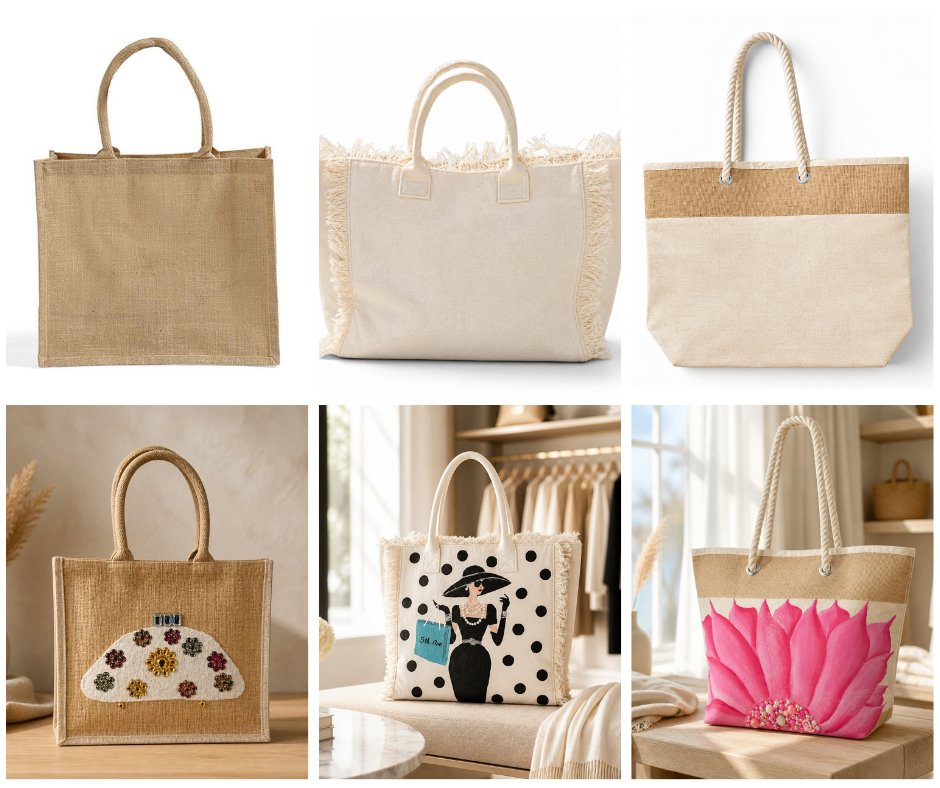
It Starts With a Real Bag — Not Just a Canvas
Before I ever pick up a paintbrush, I start with a tote I would actually want to carry.
That's important to me.
A beautiful design isn't terribly useful if the bag itself doesn't work. My totes are selected to be roomy, functional and comfortable enough to become part of your everyday life.
Depending on the style, that can mean a structured jute tote with a water-resistant interior and comfortable shoulder-length handles, or a generously sized fringed canvas tote with a fully lined interior and multiple pockets.
The goal has always been art you can actually use.
That's one of the biggest differences between what I create and a mass-produced accessory with an image printed on it. I explored that distinction more in What Makes Hand-Painted Wearable Art Different from Mass-Produced Accessories?.

Then the Blank Tote Becomes My Canvas
There is no printed image underneath my designs.
No transfer.
No machine recreating the artwork.
Each design is painted directly onto the tote by hand.
That means every face, flower, shoe, bird, heart or fashion detail begins with paint and a brush in my studio.
And painting on a tote isn't quite like painting on a traditional canvas. I'm working with texture, seams, edges and a surface that eventually has to bend and move as the bag is carried.
Sometimes I'm also painting much more than the front.
The Orange Polka Dot Muse is a great example. Her artwork doesn't end with the fashionable woman on the front. Orange polka dots continue across the back, and the bottom is painted in coordinating orange, creating a design that feels considered from every angle.
That's a lot of blank canvas to transform.

The Details Change Everything
Once the painting is complete, I start embellishing.
And this is often the moment when a design really comes alive.
Depending on the tote, I may use beads, crystals, jewelry components, glass, dimensional flowers, butterflies, metallic accents or something unexpected that I've discovered and saved because I knew someday it would be perfect for something.
The Butterfly Boot is a wonderful example. The painted boot establishes the artwork, but the dimensional butterflies and beaded details give it texture, movement and personality that simply wouldn't exist in a flat printed design.
This is also where creating one tote at a time matters.
I'm not following instructions that say, "Place crystal here."
I'm looking at the piece as I'm working and deciding what it needs.
Maybe another bead.
Maybe a different crystal.
Maybe something I planned doesn't look nearly as good in reality as it did in my head, so off it comes and I try something else.
I don't stop because I've reached a predetermined number of embellishments.
I stop when the piece looks finished.
That's part of the creative process I talked about in From Studio to Street: How My Designs Come to Life.

And Then I Have to Make Sure Those Details Stay Put
Adding the embellishments isn't the end.
The primary dimensional elements are securely attached and sealed with resin for added durability.
It's an important part of the process because these aren't pieces I expect someone to put on a shelf and admire from across the room.
They're meant to be carried.
They're meant to go shopping, travel, meet friends for lunch and become part of someone's wardrobe.
Wearable art still has to function in the real world.

No Two Are Exactly Alike
Even when I recreate one of my established designs, I am still painting it again.
By hand.
That means there will always be subtle differences in brushstrokes, embellishment placement and tiny artistic details.
To me, that's not an imperfection.
That's the point.
When something is genuinely handmade, the hand of the artist should still be visible.
It's also why each tote now includes an artist-signed Certificate of Authenticity. If I'm asking you to think of your bag as wearable artwork, I think it deserves the same sense of provenance and authenticity that accompanies other original art.
There's a Person Behind Every Bag
This may be the part that's easiest to forget when we're accustomed to clicking "Add to Cart."
When you order one of my totes, an order doesn't disappear into a factory or fulfillment center.
It comes to me.
I pull the tote. I get out the paint. I recreate the design. I choose and attach the embellishments. I resin the dimensional details. I inspect it, sign its Certificate of Authenticity, package it and send it on its way.
There are many hours of hands-on work behind the finished piece, but there's also something harder to measure: years of experimenting, learning what materials work together, figuring out how to make an idea translate onto a bag, and developing a style that has become recognizably mine.
That's part of what handmade means too.
So, What Does $100+ Buy?
Yes, it buys you a tote.
But it also buys you original hand-painted artwork.
It buys you dimensional details selected and placed individually.
It buys you a piece that was created by an artist rather than reproduced by a machine.
And it buys you something that's both beautiful and useful — because I don't believe art has to stay on the wall.
You can see just how many different personalities wearable art can have in The Women Series, where glamorous, playful, colorful and sophisticated women each become their own statement piece.
And if you're wondering whether a statement accessory is something you'll really use, you might enjoy Why Statement Accessories Are Worth the Investment.

More Than Something to Carry
I love the moment when a finished tote is sitting on my worktable and I can barely remember what the blank bag looked like.
That's when I know it's done.
It has become something with personality.
Something its future owner won't see coming and going everywhere she looks.
Something that might make a stranger stop and ask, "Where did you get that bag?"
And to me, that's what a statement tote should do.
It carries your things.
But it also carries a little bit of art, individuality and joy out into the world.
Hand-Painted. Heart-Filled. Always Uncommon.

Written by Dana Harding

Leave a comment
This site is protected by hCaptcha and the hCaptcha Privacy Policy and Terms of Service apply.